
Running a Sex Offender Check in Potter County
The Pennsylvania State Police Megan's Law Public Website is the authoritative channel for Potter County registry checks. Every visitor must accept terms that explain the public-safety purpose, possible data limits, identity cautions, and penalties or civil liability for misuse. The database updates daily, while its map provider may follow a different update cycle.
Start with a county search for a broad Potter County list. Then use municipality or ZIP/radius tools for Coudersport, Shinglehouse, Galeton, or a rural address. A name search works when the person is known. Internet Identifier Search covers usernames or similar identifiers published under the statute. PSP does not identify a separate Potter County sheriff registry, app, or public registration-counter schedule.
These channels are free and open to the public after the warning gate. No account is needed for a one-time search. An account or contact method is used for alert features. Search results are tied to statutory publication rules, not to every past offense that a court may have recorded. A Potter County court case and a registry profile therefore answer different questions and should not be treated as interchangeable records.
Only statutorily covered registrants appear. The absence of a person from a Potter County search is not proof that the person has never had a sex-offense conviction, and an entry does not say that a new offense occurred. Registration duties depend on the governing law, conviction, classification, and history. Use the registry for its stated public-awareness role, then use court records if the goal is to understand a specific prosecution or sentence.
Potter County Registry Search Routes
County, municipality, and ZIP searches answer different questions. County Search gives the widest Potter County starting set. Municipality Search narrows results to a borough or township. ZIP/Radius Search is useful for a home, school route, park, or other place, but it depends on an address the mapping tool can recognize. Searching more than one way reduces the chance that spelling or map limits hide a relevant public entry.
The manifest's official Megan's Law county-search view shows the Potter County filtering route:
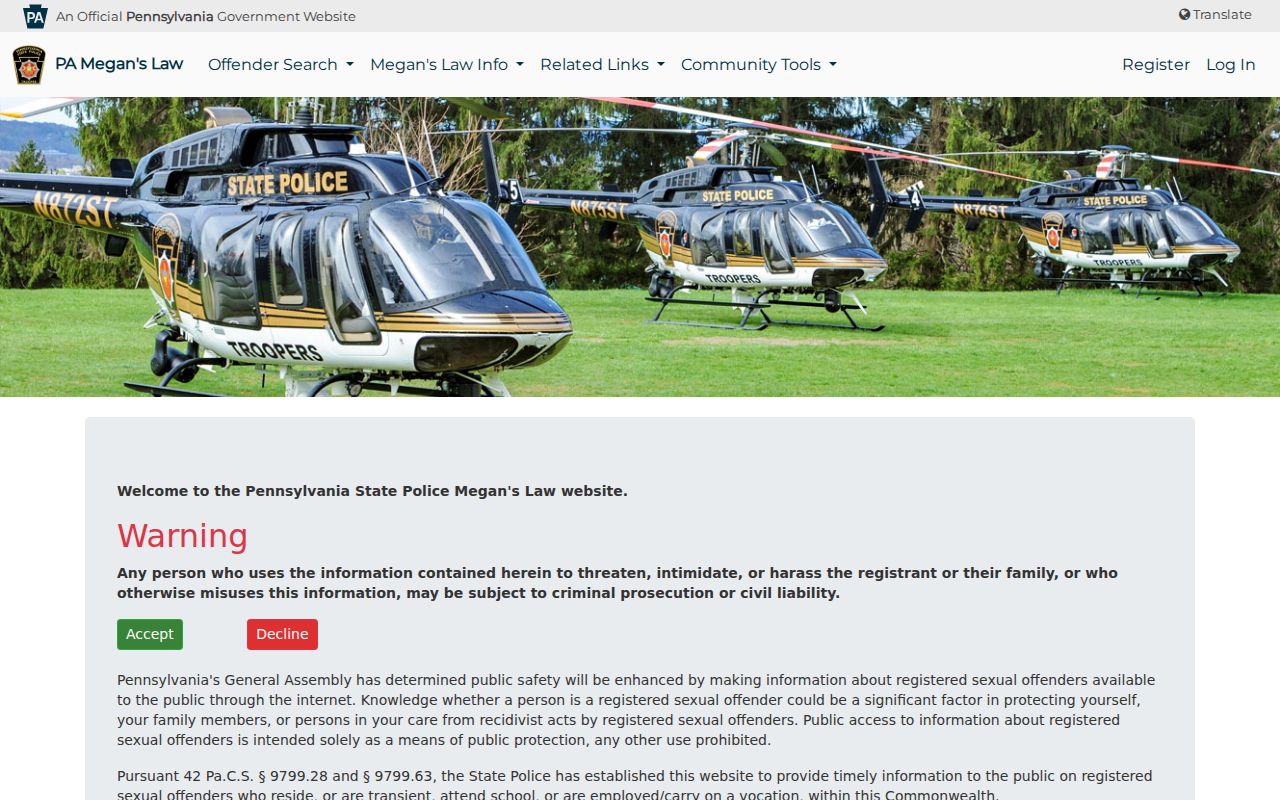
This statewide tool is the local countywide list; there is no verified duplicate Potter sheriff database to reconcile.
Municipality and county names matter in Potter's rural setting. The county includes boroughs and many townships, and a mailing name may not match the municipality field a user expects. Run County Search first if a borough-only search seems too narrow. Then check the written profile instead of relying only on its map. This process is more sound than widening a ZIP radius until unrelated locations dominate the result list.
Searching the Pennsylvania State Police Megan's Law Public Website
Use the PSP registry itself, not an unofficial people-search service. The search requires agreement to the terms before it opens. Search results may appear as a list or map, and each detail page must be read with care. A registry listing is not fingerprint identification. Match all available public facts and contact PSP when an address or status needs clarification.
- Open the PSP Megan's Law website and read, then accept, the lawful-use terms.
- Choose Name, County, Municipality, ZIP/Radius, or Internet Identifier Search.
- Select Potter County or enter the location and radius that fit the safety question.
- Open a public profile, compare its fields, and avoid treating a map pin as a complete assessment.
| Field Label | Type | Required | Notes |
|---|---|---|---|
| Accept/Decline Terms | Buttons | Yes | Accept the lawful-use conditions to search |
| Name Search | Form | Conditional | Use a registrant name when known |
| County Search | Dropdown | Conditional | Select Potter for countywide results |
| Municipality Search | Dropdown | Conditional | Choose a borough or township |
| ZIP/Radius Search | Address and map form | Conditional | Map results depend on a recognized address |
| Internet Identifier | Text form | Conditional | Search a statutory online identifier |
The official ZIP and radius interface illustrates the proximity workflow:
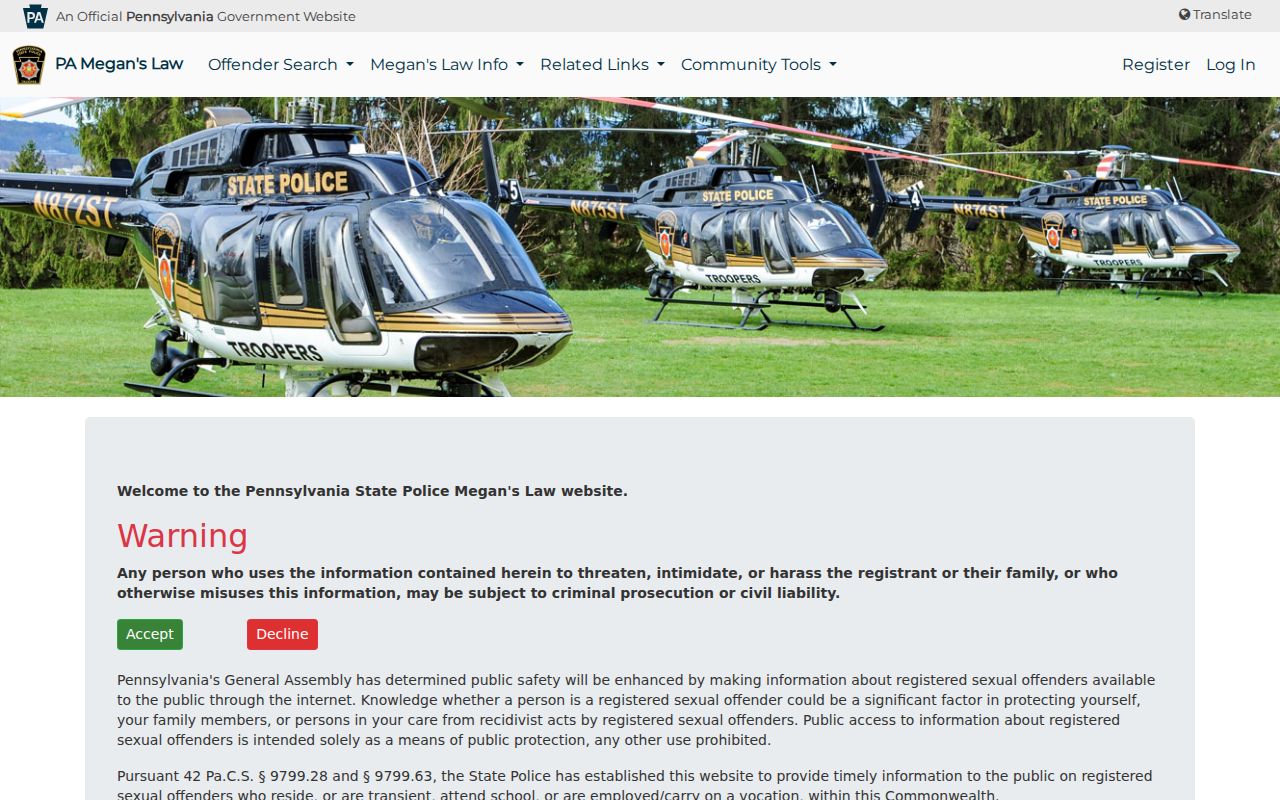
For rural Potter County, pair that map search with the county list when an address does not map cleanly.
Review the result list before opening profiles. Compare names and available location details, but remember that the warning says a listing is not fingerprint identification. A shared name does not prove identity. PSP updates registry data daily, yet a reported change and a map display may not move at the same moment. For help with a possible error, use the registry section's official phone channel rather than drawing a conclusion from one search.
The alert registration control is optional and separate from the search itself. A user can label an address and choose notices without changing any public profile. Map and list controls only change the way results display. They do not rank people by risk. If a Potter County query produces a long list, narrow by municipality or ZIP after saving the broader county context, not by assuming the nearest pin is the only relevant result.
Non-Mappable Potter County Registry Addresses
On the PSP registry, “non-mappable” means Google could not plot an incomplete or unrecognized address. It does not mean PSP removed the profile, the registrant has no reporting duty, or the person is outside Potter County. Rural routes, transient descriptions, and unusual address formats can cause that label. Use the list view and read the profile's written municipality, county, ZIP, residence, or transient details.
If the location remains unclear, call the PSP Megan's Law Section at 1-866-771-3170. Do not visit an address or confront anyone. The map is one display layer for data supplied by registrants and reporting entities, not a live position tracker.
Transient registrants can have a habitat, temporary abode, or frequented location described without a standard street address. Their normal in-person verification schedule is monthly for the applicable registration period. That context is especially important in Potter County, where long rural routes and sparse addressing can make a pin seem more exact than the source data supports. Written profile fields carry meaning even when the map cannot draw a point.
What a Registry Profile Shows
A Potter County public profile combines identity, location, classification, and qualifying offense information that Pennsylvania law permits PSP to publish. It can show several addresses and aliases, plus work or school data within statutory limits. The profile does not contain every fact in a criminal case, and it does not prove that the listed person is at the mapped spot at a given moment.
| Name and Aliases | Current name and alternate names PSP is authorized to display |
|---|---|
| Photo and Description | Recent photographs, birth year, gender, race, height, weight, hair, eyes, and published marks |
| Locations | Residence or intended residence, temporary abode, transient habitat, and certain frequented places |
| Work and School | School or institution plus fixed job location or general work area when authorized |
| Offense | Qualifying offense, statute, jurisdiction, and conviction information |
| Classification and Status | Tier or other status, registration details, and verification information |
The PSP registry FAQ and profile-field explanation provides the official basis for reading these fields:
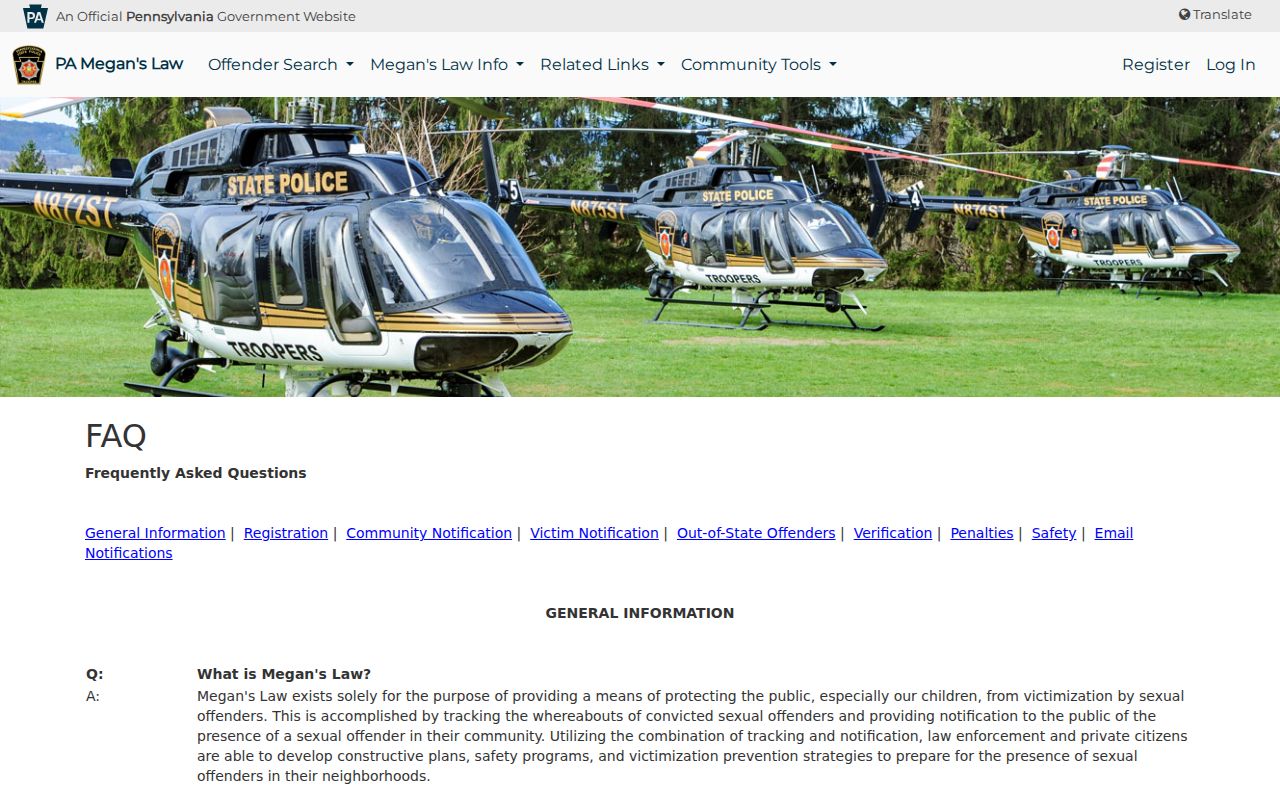
That source also stresses that registry information may be incomplete or out of date and is not a substitute for fingerprint identification.
Some profiles may include scars, marks, tattoos, vehicles, mapping status, or contact and update notices when state law authorizes publication. The presence or absence of one field does not by itself show compliance. Read the classification and verification information in context. For the related court disposition or sentence, use official court records; the public registry is not a full criminal docket and does not reproduce every filing.
Residence fields may include all reported residence or intended-residence addresses. Work information can be a fixed location or a general area, depending on what the law authorizes. School fields identify an institution where applicable. Recent photographs and physical traits help with public identification, yet PSP still warns that fingerprint comparison is the sure identity method. Never identify a person from one photo, alias, or map point alone.
Potter County Registry Address Alerts
The PSP registry allows a user to label an address and request notifications. The service processes alerts daily when covered registry information triggers its rules. This tool can add ongoing awareness around a Potter County location after the first search. It is not an emergency alert, a promise that every move will appear at once, or a substitute for checking the current registry.
Use a clear label for each saved place so notifications can be understood later. If a notice raises an immediate safety concern, call 911. Questions about registry data or the correct local update channel belong with the Megan's Law Section, not the Potter County courthouse.
Alert processing responds to covered changes around the saved location. It should be part of a routine safety plan, not a signal to watch, follow, or contact anyone. A household can keep the location label current, revisit the live Potter County search after receiving a notice, and use PSP for clarification. No official local community-notification meeting schedule was found, so the state address-alert tool is the documented ongoing channel.
Registration Requirements and Levels in Pennsylvania
Pennsylvania uses statutory tiers that set the usual registration duration and in-person verification schedule. These labels do not act as a simple scale of day-to-day risk. Potter County entries can also include legacy categories governed by different ten-year or lifetime schedules. Use the current state registration page for the offense lists and any exception rather than guessing a tier from an offense name.
| Level / Tier | Duration | Verification Frequency |
|---|---|---|
| Tier I | 15 years | Annually |
| Tier II | 25 years | Twice yearly |
| Tier III | Lifetime | Quarterly |
| Transient registrant | Applicable duration | Monthly |
| SVDC or SVP | Applicable statutory or lifetime rule | Quarterly |
The official PSP registration page explains the tier and verification rules:
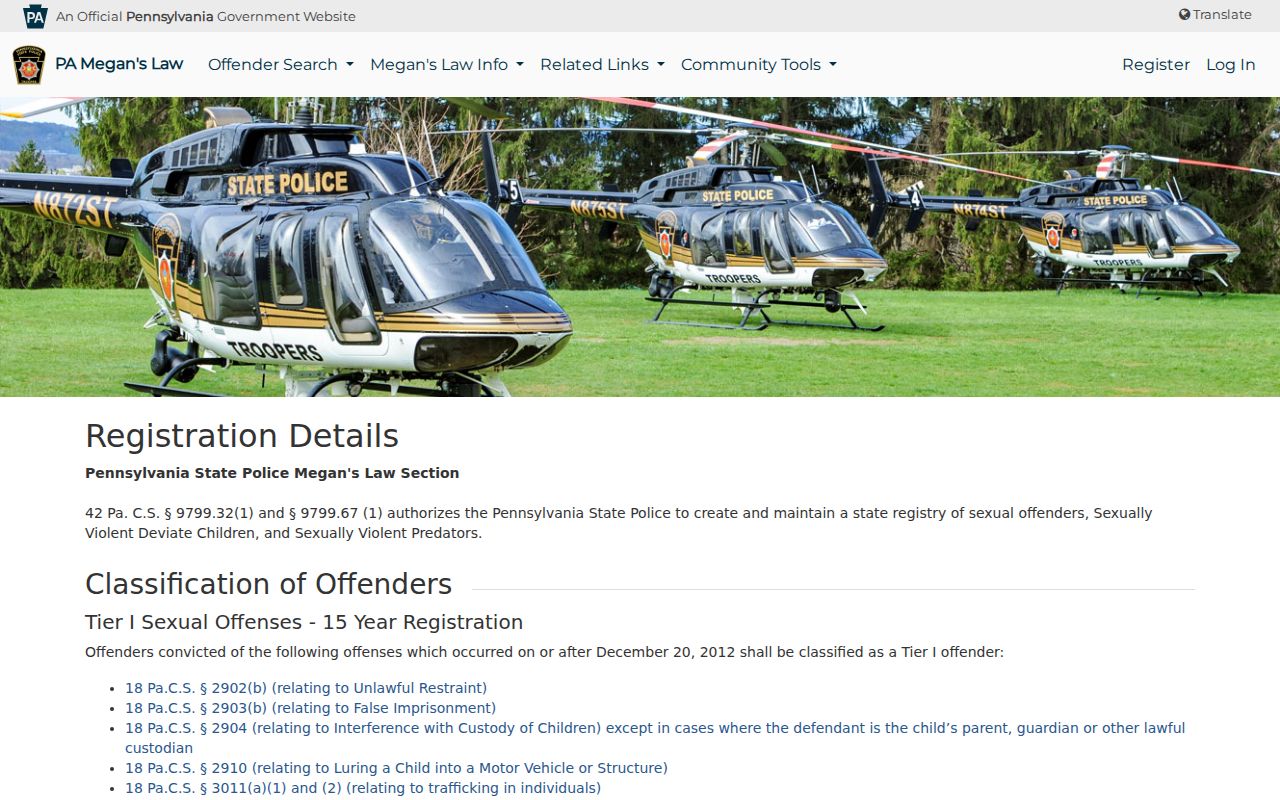
Qualifying Tier II or III registrants may use a modified verification process after three compliant years and no disqualifying new offense, so the current PSP rule controls.
Under that modified process, a qualifying person may make one annual physical appearance and complete other verifications by telephone within three business days. The verification line, 1-855-791-1990, confirms existing data and does not accept changes. This exception is one reason not to infer noncompliance from the time since an in-person visit. PSP evaluates duties under the current statute and the person's actual classification.
Legacy Pennsylvania categories can follow ten-year or lifetime registration periods with annual schedules that do not fit the modern three-tier table. Sexually Violent Predators and Sexually Violent Delinquent Children have their own statutory rules. Do not translate a federal SORNA label into a Pennsylvania duty without the current state page. Duration, frequency, and public visibility must be read from the controlling classification and profile.
Potter County Checks Across State Lines
The National Sex Offender Public Website maintained by the U.S. Department of Justice adds a cross-state search layer. It is useful when a name, address, or safety concern may involve New York or another state as well as rural Potter County. NSOPW queries participating jurisdictions, while PSP remains the source for Pennsylvania profile details and state-specific registration rules.
The national portal shown in the manifest broadens the geographic reach of a Potter County check:
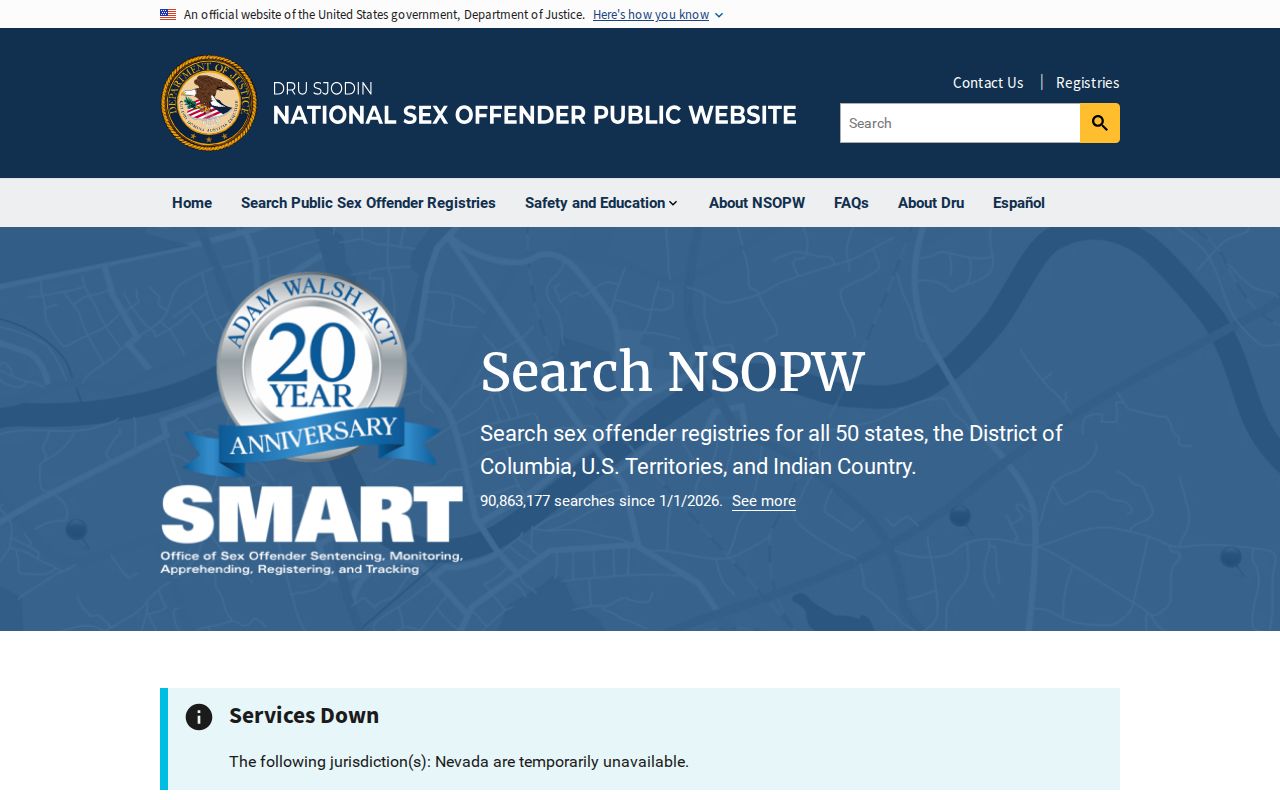
Use both tools when state lines matter, then return to the source jurisdiction for the most specific profile and contact channel.
NSOPW does not replace the PSP alert system, Potter County address search, or emergency reporting. Jurisdictions control the information that feeds the national portal. A national name result should lead back to the relevant state or tribal profile for its legal terms and update details. When the profile is Pennsylvania-based, the Megan's Law website and PSP help line remain the controlling sources.
Report Potter County Registry Noncompliance
Suspected noncompliance should go to PSP, not to a personal investigation. Call the Megan's Law Section at 1-866-771-3170 for registry errors, help, or guidance. The PSP Coudersport station at 3084 East Second Street can be reached at 814-274-8690. An emergency belongs with 911.
No official source publishes a separate Potter County Sheriff registration schedule. Call PSP for the correct local registration or update instructions instead of assuming that the courthouse accepts them. Record the public profile and the specific issue that caused concern, then let trained officials verify it. Do not contact, follow, photograph, or confront the person or family.
A suspected missed update and a data-display problem are not the same. State staff can check the registry record, while local PSP can address an immediate local report. Give the public facts that led to the concern without making claims about guilt or intent. The registry itself warns that information can be incomplete or outdated. Official review is the safe route for both accuracy and lawful use.
The Coudersport station is part of PSP Troop F and is the documented local state-police contact. Its office is not a substitute for the public website's search and alert tools. Call before travel if PSP directs an in-person step. Registry changes and required appearances are the registrant's duty, while a member of the public should use the help and report channels only for a real question or observed concern.
Lawful Use and Community Notification
Potter County registry information is meant for personal, family, and community awareness. A pin does not prove that a person is at that spot, measure current risk, or list every person ever convicted of a sexual offense. Only people covered by Pennsylvania's registration laws appear. Addresses and work or school details can change, so confirm an unclear result with PSP.
Registry misuse warning: Threatening, intimidating, or harassing a registrant or family may lead to criminal prosecution or civil liability under 42 Pa.C.S. §§ 9799.32 and 9799.67.
Use ordinary safety steps based on verified facts. Save an address alert, check the list as well as the map, and call the official help line when a public field appears wrong. The warning applies before every search and protects both lawful public access and the people named in the registry.
Pennsylvania's public system is authorized by 42 Pa.C.S. §§ 9799.32 and 9799.67. Those provisions define the scope of public information and sit alongside the warning against misuse. They do not turn a profile into permission for vigilantism, exclusion, or punishment. Personal and family safety decisions should use current facts, normal emergency channels, and measured planning instead of assumptions about a tier label or mapped point.
Keep the registry in proportion. It can show covered public facts, offer address alerts, and point a reader to the responsible state office. It cannot predict conduct, confirm live presence, or replace a broad community safety plan. In Potter County, the most reliable practice is to use county and location searches together, read full profiles, check NSOPW when state lines matter, and send uncertainties to PSP.