
Criminal Cases in the Potter County Courts
Potter County is Pennsylvania's 55th Judicial District. The Court of Common Pleas hears felony and misdemeanor cases after the preliminary stage. Three Magisterial District Courts handle complaints, preliminary arraignments and hearings, bail, warrants, traffic cases, and summary matters in their assigned areas. One prosecution may have an MDJ docket first and a later CP docket in Coudersport. Searching only one court can hide part of the Potter County case history.
The Potter County courts directory identifies the Common Pleas court and all three MDJ offices. The public docket tracks judicial action, not the arresting agency's full report. The Clerk of Courts keeps the Common Pleas criminal file. Each MDJ office keeps its own first-level paper record.
The Court of Common Pleas has one Potter County judgeship. That compact bench does not combine the records held by other offices. The Sheriff may execute an order, the District Attorney may file a charge, and Adult Probation may supervise a sentence, but the filed criminal case remains with the court. A police incident narrative is likewise separate. This division explains why a single request to “the courthouse” may not yield every document a reader expects.
The main court contacts show how that custody is divided:
| Court | Criminal Role | Potter County Contact |
|---|---|---|
| Court of Common Pleas | Trial-level felonies, misdemeanors, pleas, trials, sentences, and summary appeals | Room 23, 1 East Second Street; 814-274-9740 |
| MDJ 55-3-01 | Complaints, bail, warrants, preliminary, traffic, and summary matters | 24 Mapleview Lane, Suite 1; 814-274-9411 |
| MDJ 55-4-03 | First-level proceedings for its district | 28 Bridge Street, Suite 1; 814-435-2642 |
The official court directory gives a useful view of that split:
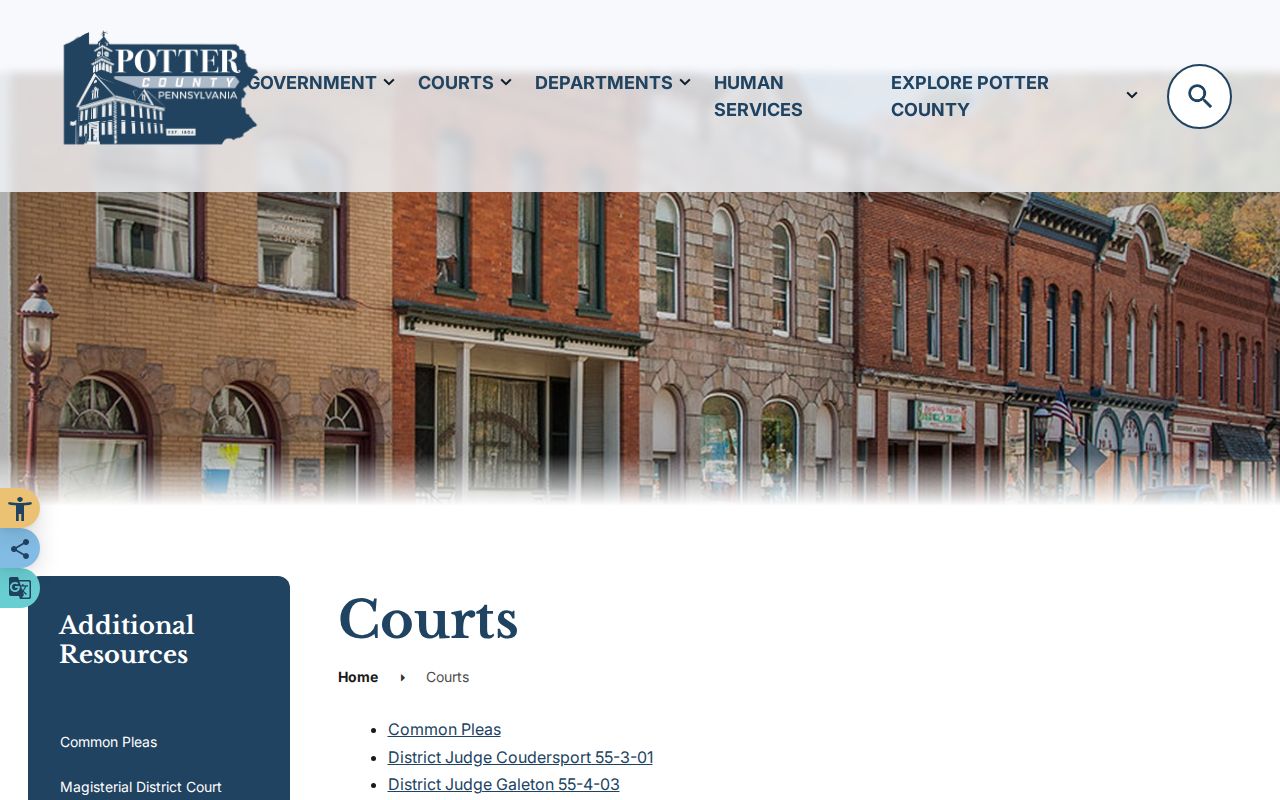
The directory helps a reader choose the office that owns the Potter County criminal case record before calling or traveling.
Potter County Case Court Paths
Coudersport MDJ 55-3-01 is at 24 Mapleview Lane, Suite 1, and can be reached at 814-274-9411. Galeton MDJ 55-4-03 is at 28 Bridge Street, Suite 1, with phone 814-435-2642. Shinglehouse MDJ 55-4-01 serves western Potter County. Its current address and phone should be checked on the county court page before travel because the research found a cross-office contact inconsistency.
These courts create the complaint-stage record, address bail and warrants, and decide whether charges should advance. Once a felony or misdemeanor is held or waived for court, the District Attorney files the criminal information and the Potter County Common Pleas docket carries the later case. Traffic and summary cases may remain at the MDJ level, subject to any appeal.
Potter County spans more than a thousand land square miles. Galeton and Shinglehouse have local MDJ offices because a first hearing need not begin at the county-seat courthouse. The same geography makes a call before travel useful. Confirm the office, docket type, paper-copy procedure, and public-counter availability first. A Common Pleas search does not replace the local MDJ search when the case is still in its early stage.
How to Search Case Records
The free Unified Judicial System Case Search is the best first stop for Potter County court cases. It covers public MDJ and Common Pleas dockets. Start with few fields, then narrow the result set. A name alone does not prove identity, so compare the county, filing date, OTN, arresting agency, and other public details before relying on a result.
- Open Case Search and choose Participant Name when no exact identifier is known.
- Enter a minimal first and last name, then select Potter County.
- Check both MDJ and Common Pleas results, or search by OTN, docket, incident, or complaint number.
- Open the full docket sheet and compare identifiers, charges, events, bail, and disposition entries.
- Ask the relevant MDJ or Clerk of Courts for a filing, paper copy, or certification that UJS does not provide.
| Field Label | Type | Required | Notes |
|---|---|---|---|
| Search By | Dropdown | Yes | Participant, docket, OTN, SID, incident, complaint, citation, and other routes |
| Participant First/Last | Text | Conditional | Begin with first name, last name, and county |
| County | Dropdown | No | Select Potter to limit statewide results |
| Judicial District | Dropdown | No | Potter is Judicial District 55 |
| Court or MDJ Office | Dropdown | No | Choose Common Pleas or the known MDJ office |
| Date Filed | Date range | No | Use after a broad search returns too many cases |
A view of the official statewide search shows why exact field choices matter:
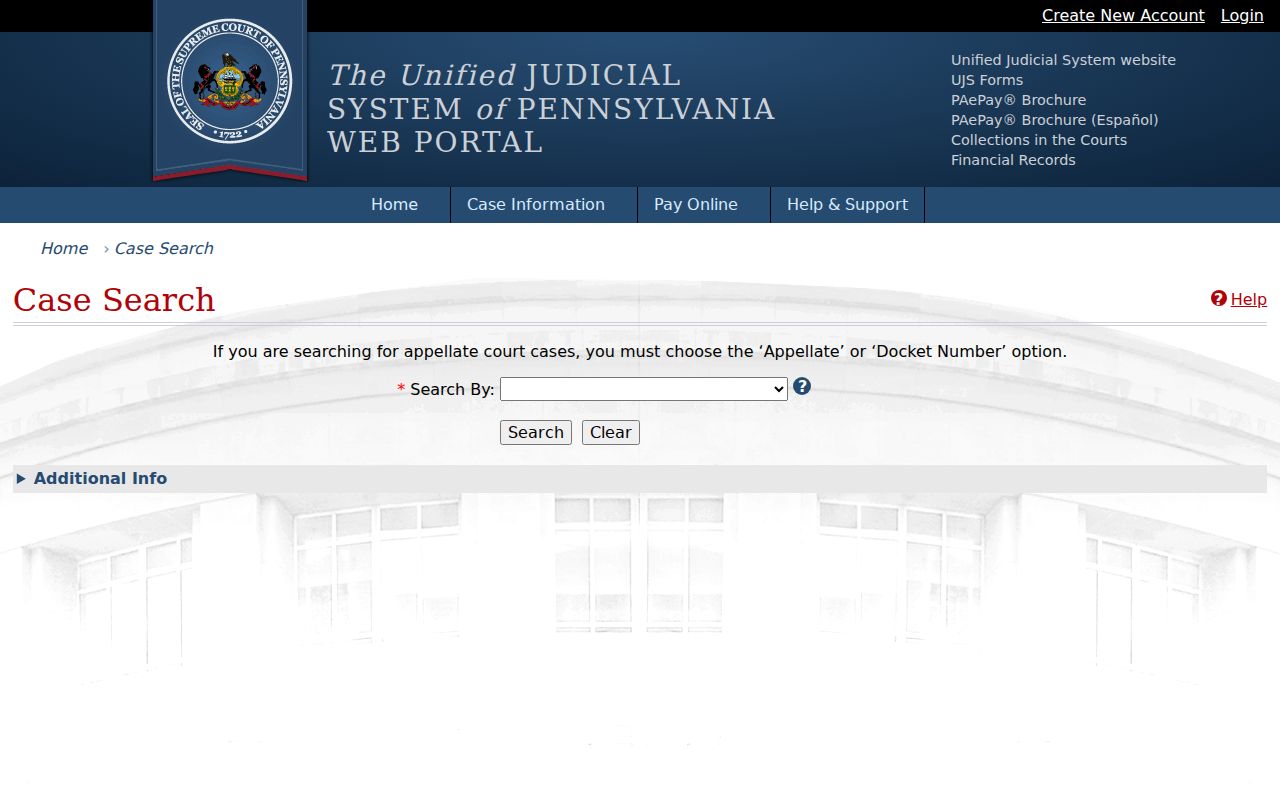
The UJS form supports both broad participant searches and precise identifier searches for Potter County dockets.
UJS also offers PAeDocket as an official mobile companion. It can search by case number, participant or organization, OTN, incident or complaint number, and SID. The full web portal exposes a broader set of filters and is better for printing a complete docket. JavaScript and cookies must be enabled. When a broad Potter County name search fails, remove added filters before concluding that no public docket exists.
An incident number comes from the police event, while a complaint number identifies the first charging paper. The OTN follows the criminal episode across systems, and the SID is a state identity number tied to fingerprint-supported records. Use an exact identifier when available. Otherwise, search a short name first and confirm identity from the full docket rather than adding many fields that may contain a spelling or date mismatch.
Potter County Case Files in Room 23
A UJS docket lists filings and court events, but it does not make the filed documents downloadable to the general public. The Potter County Clerk of Courts counter is in Room 23 at 1 East Second Street, Coudersport, PA 16915. Call 814-274-9740 for a plain copy, certified copy, archive question, or counter inspection. Posted hours are Monday through Friday, 8:30 a.m. to 4:30 p.m., with a noon to 1 p.m. lunch closure.
The Clerk of Courts page records two unusual mail and filing rules. Double-sided documents are returned. Requested documents go back by USPS First Class only when the requester supplies a correctly posted self-addressed envelope. Check the linked fee schedule on the day of the request because the research could not verify a stable criminal-copy or certification price.
The county clerk page shows the local source for those Potter County court documents:
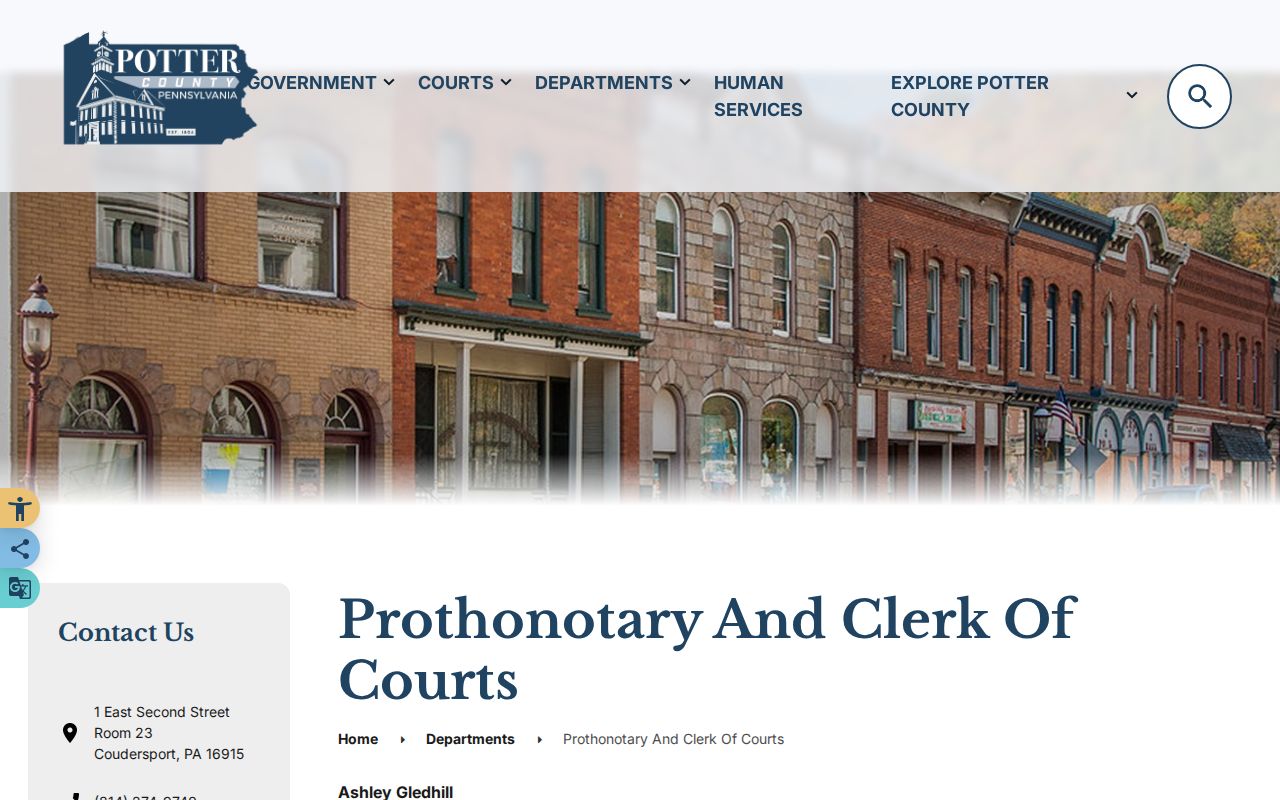
That office, not the public portal, supplies complaints, informations, orders, sentencing papers, and certified filings.
A mail request should name the court, docket number, document, and copy type. Include the correctly addressed return envelope and enough postage for the requested packet. FedEx or UPS may deliver a filing, but the Clerk's posted rule limits its return of requested documents to USPS First Class. For an in-person visit, remember the noon closure and ask about the present copy fee before placing a large order.
What the Case File Shows
A Potter County criminal case file links the court's identifiers to its action on each charge. The result row is only an index. The docket sheet and filed papers show how the allegations changed, which events occurred, and what the court finally ordered. Read each count on its own because one case can contain a conviction, dismissal, and withdrawn or nolle prossed charge at the same time.
| Case Number and Court | Judicial district, docket type, filing date, status, judge, and originating MDJ when shown |
|---|---|
| Identifiers | OTN, incident or complaint number, arresting agency, and public participant details |
| Charges | Count sequence, statute, offense text, grade, disposition, and disposition date |
| Events and Bail | Arraignments, hearings, motions, conferences, bail type, amount, status, and changes |
| Filed Documents | Docket entries identify complaints, informations, orders, and motions; the clerk supplies the actual paper |
| Sentence | Confinement, probation, fines, costs, and concurrent or consecutive terms when entered |
The official UJS case-information page distinguishes free public docket views from secure reports:
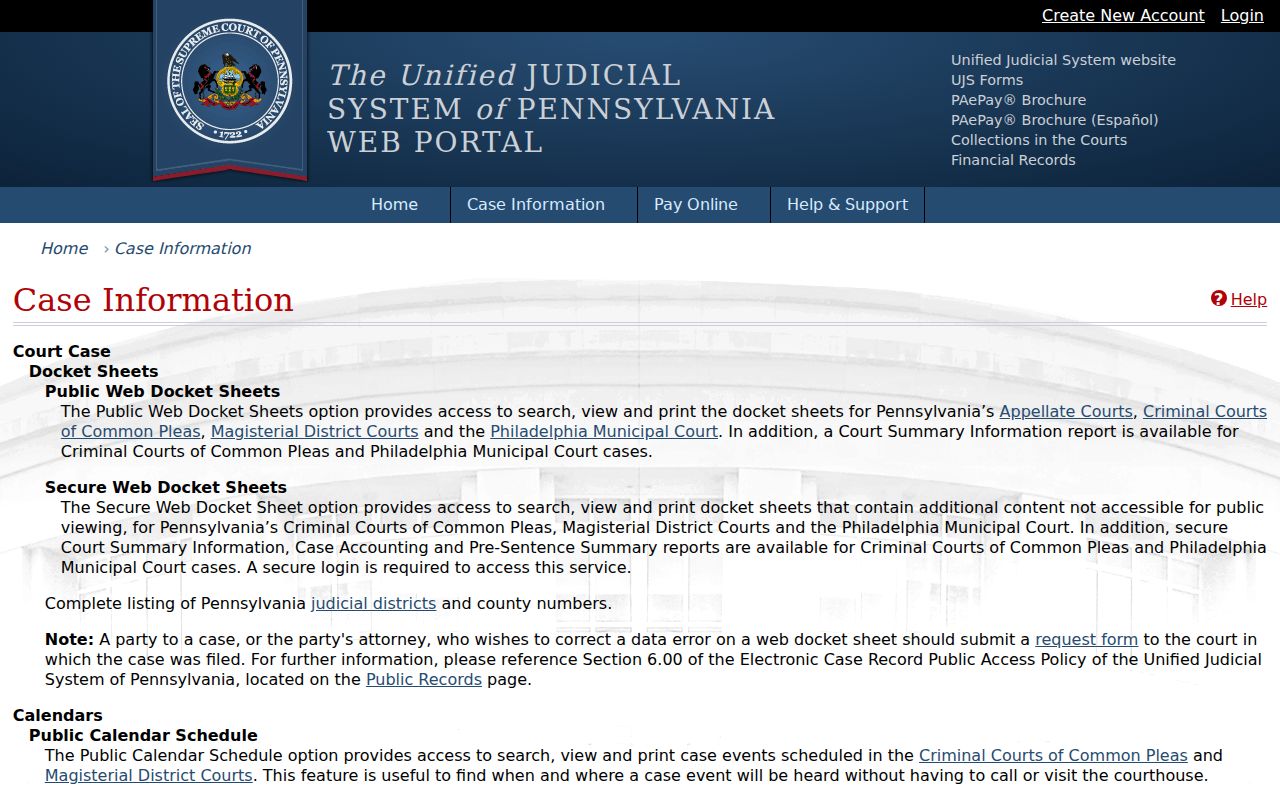
Ordinary public users do not receive secure Case Accounting or Pre-Sentence Summary reports through the open portal.
A court file differs from a PSP rap sheet. The court file organizes one prosecution around a docket, judge, charges, events, and outcome. A repository record connects fingerprint-supported arrest cycles to reported dispositions across Pennsylvania. A jail booking record is only a custody snapshot. Temporary differences can occur as charges are amended or disposition reporting catches up. For case meaning, the Potter County docket and filed order are the key sources.
Calendar entries can list the event type, time, place, and judge. Bail rows may show type, amount, percentage, status, or later changes. Sentence rows can separate confinement, probation, fines, costs, and restitution, with concurrent or consecutive terms where entered. The public docket can identify these items without exposing protected pre-sentence reports, private victim data, attorney notes, or confidential supervision and treatment material.
Reading Potter County Case Dockets
Several short terms unlock a Potter County docket. An OTN is the Offense Tracking Number that connects the criminal episode across systems. A complaint is the first charging document, while an information is the prosecutor's formal Common Pleas charging paper. A disposition is the outcome recorded for a charge. Nolle prosequi means the prosecutor formally chose not to proceed on that count, subject to court action.
- Held or waived for court
- The MDJ stage ended with the charge moving to Common Pleas.
- Grade
- F1, F2, F3, M1, M2, M3, or summary marks the Pennsylvania offense level, not the outcome.
- Concurrent
- Sentences run at the same time to the extent the judge orders.
- Consecutive
- One sentence starts after another as ordered.
A dismissed count can remain visible unless later relief restricts it. Likewise, a charge grade may change between the complaint and final disposition. Read the full event and charge tables instead of treating the first listed offense as the final Potter County result.
Pennsylvania grades charges by degree. F1, F2, and F3 are felony grades; M1, M2, and M3 are misdemeanor grades. A summary matter is generally handled by an MDJ, with an appeal route to Common Pleas. The grade describes the charge and its ordinary penalty range. It does not say whether the charge ended in conviction. Always pair the Grade column with the Disposition and Disposition Date columns.
Stages of a Criminal Case
A Potter County case may begin with an arrest or summons and a complaint before an MDJ. The MDJ conducts the preliminary arraignment, addresses bail, and holds or waives a preliminary hearing. If charges advance, the District Attorney files an information in Common Pleas. Formal arraignment, motions, conferences, a plea or trial, sentence, and later motions or appeal then appear on the CP docket.
Case flow: Charges Filed › Arraignment › Pretrial › Plea or Trial › Disposition › Sentencing
The Potter County District Attorney reviews and prosecutes charges after they reach the right stage. The office is not a neutral records-search desk. Its official page provides useful context:
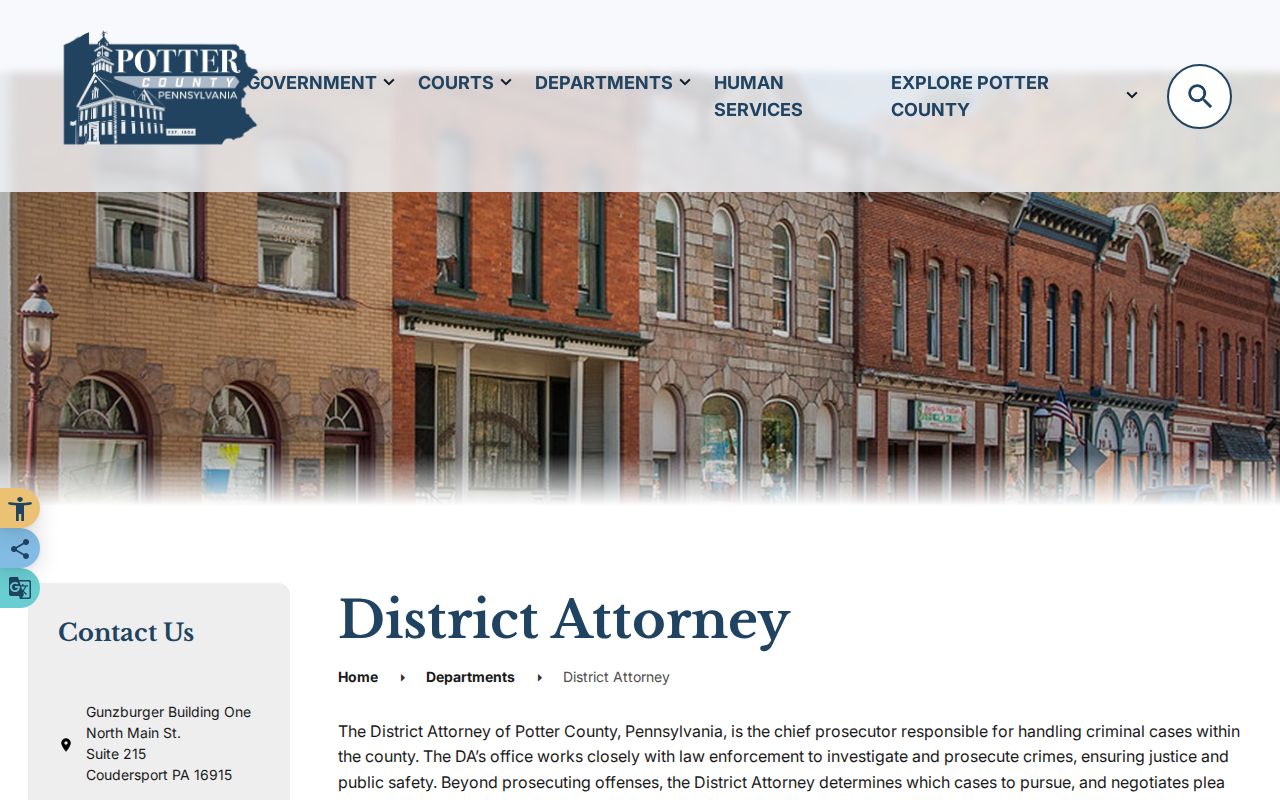
The prosecution office's work becomes part of the court record through filed informations, motions, pleas, and outcomes.
The Potter County District Attorney is at 1 North Main Street, Suite 215, and can be reached at 814-274-9450. The Victim/Witness Coordinator provides rights information, court accompaniment, restitution or compensation help, and referrals. Those services are distinct from neutral record access. The Clerk remains the custodian for public filed papers, while the docket records when the Commonwealth and defense take formal steps in court.
A plea can resolve some counts while others are withdrawn or dismissed. A trial can produce different outcomes across counts. Sentencing follows the conviction outcome, but post-sentence motions and appeals can add later entries. For that reason, the last visible row is not always the clearest answer. Read the charge-disposition table, sentence section, and latest case status together, then obtain the signed order when the exact Potter County judgment matters.
Potter County Case Counsel Records
The docket may name defense counsel, but an attorney's file is not the public court file. Potter County's Public Defender is in the Gunzburger Building at 1 North Main Street, Suite 134, Coudersport. The office phone is 814-274-8288. Its application asks a person seeking appointed representation for case and eligibility details. Those attorney-client materials do not become a public case-search product.
The Potter County Public Defender page explains that separate role:
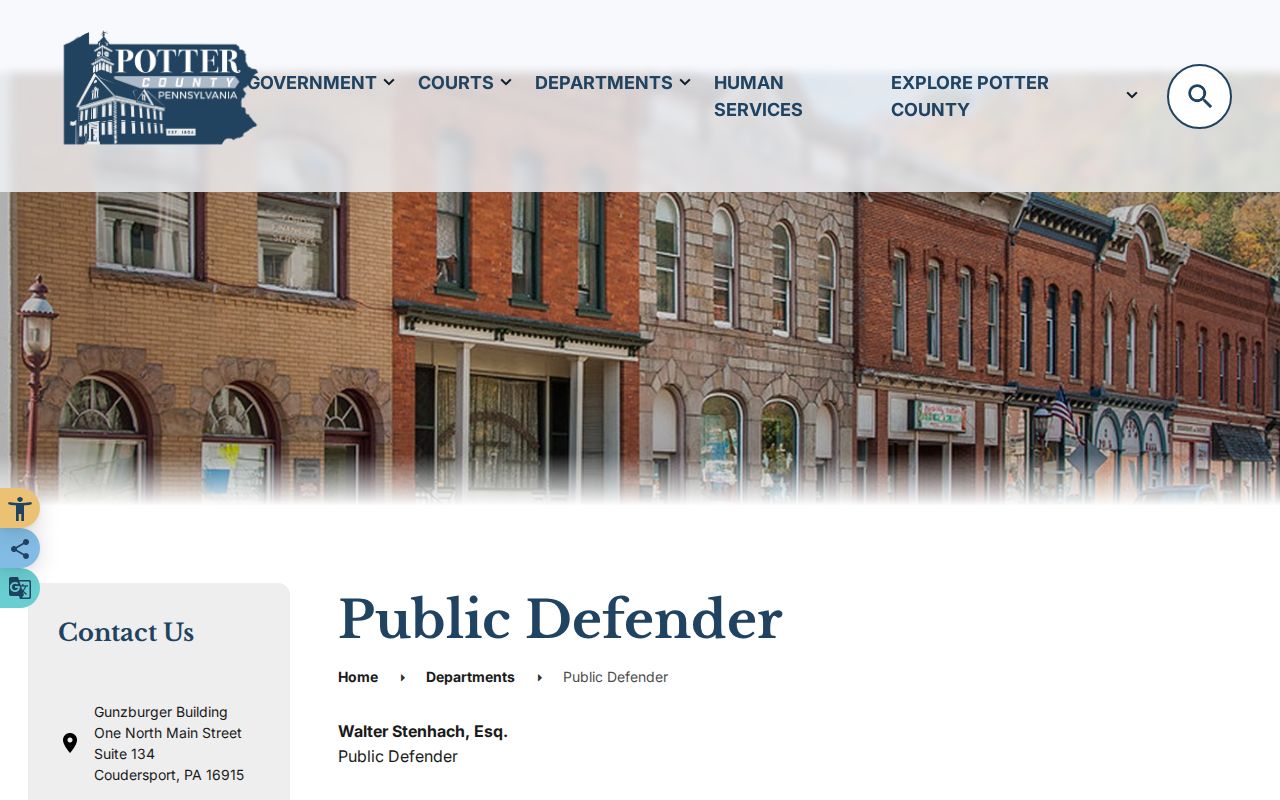
For a docket, order, or filed motion, use UJS and the court clerk. Contact counsel only about representation and the person's own legal matter.
A reader researching their own case should separate three tasks. Use UJS to see public events. Ask the Clerk for the filed order or sentence. Speak with counsel for advice about what those papers mean and what action is available. Clerk staff can describe copy procedures but cannot act as counsel. Public Defender staff handle representation and eligibility, not general Potter County background searches.
Missing Potter County Case Results
A correct name can still return no Potter County case. UJS excludes juvenile cases, expunged and pending-expungement dockets, sealed matters, qualifying limited-access records, and files removed under retention rules. A spelling change, narrow date range, or search in only one court can also hide a public result.
First clear extra filters and search the MDJ and Common Pleas dockets. Try the OTN, complaint number, or docket number when known. If the record is your own, compare the court result with the proper Pennsylvania State Police record-review channel. The Clerk can explain whether an older public paper index exists, but staff cannot disclose a protected Potter County case merely because it is absent online.
Clean Slate limited access and expungement are not the same. Limited access suppresses ordinary public dissemination while preserving access for courts and criminal-justice agencies. Expungement follows 18 Pa.C.S. § 9122 and has separate eligibility and notice rules. A person auditing their own Potter County history should identify the exact docket and count outcome, obtain any certified relief order, and later verify both UJS suppression and PSP correction.
Access & Restrictions
Public UJS docket viewing and printing are free under the UJS Public Access Policy. Yet public access has firm limits. Juvenile matters, sealed files, expunged and pending-expungement dockets, qualifying Clean Slate limited-access cases, victim contact details, Social Security numbers, and other protected data do not appear in an ordinary public search.
A missing Potter County case result does not prove that no case ever existed. Recheck the spelling, court, OTN, and date range. Then call the correct MDJ or Room 23. Older records may need an archive search, while a protected case may remain unavailable. The Pennsylvania Right-to-Know Law does not bypass court sealing or criminal-investigative limits. Court records follow judicial access rules and clerk procedures.
The Criminal History Record Information Act governs Pennsylvania criminal-history collection and dissemination, while the judicial access policy governs public court dockets. A county Right-to-Know request may reach an administrative record, but it is not a shortcut around either system. Ask the creator or custodian for the specific record: police for an incident report, the MDJ for its complaint-stage paper, and the Clerk for the Common Pleas filing.
When the Clerk cannot release a requested item, ask which access rule or court order controls and whether a public redacted version exists. A request for a named filing is more useful than a broad demand for “everything.” State the docket number, count or document title, filing date if known, and whether a plain or certified copy is needed. That precision helps Potter County staff find the correct public record without asking them to interpret the case.
For a broad overview of how court, repository, and agency files differ, the Potter County criminal history page sets out the full records chain.